

VOXA – Universal Secure Distributed Communication Ecosystem
VOXA – A Secure, Autonomous, and Scalable Communication Platform for Enterprise Environments
VOXA is an independently operated communication ecosystem designed to support mission-critical corporate infrastructures.
The platform provides a unified architecture combining encrypted transport protocols, a modular communication core, hybrid networking capabilities, and cross-platform deployment options.
At the core of VOXA lies a hybrid communication model that combines client-server routing, secure peer-to-peer channels, and adaptive encrypted transport layers.
This approach allows VOXA to remain stable under high load, unpredictable connectivity or restricted environments.
VOXA allows organizations to build dependable, secure, and fully controlled communication systems without reliance on external cloud providers.


Three Pillars of the VOXA Ecosystem
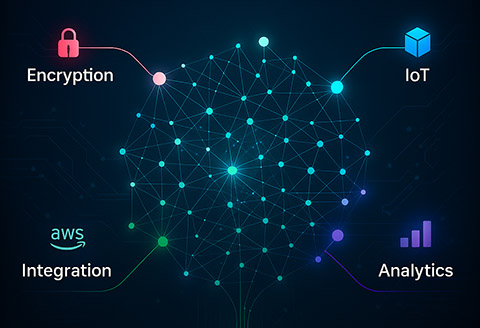
Architecture
A multi-layer distributed system designed for modular expansion, low-latency communication, and secure interoperability.
Devices, gateways, services, and custom modules connect through a unified protocol stack engineered for speed, reliability, and long-term scalability.
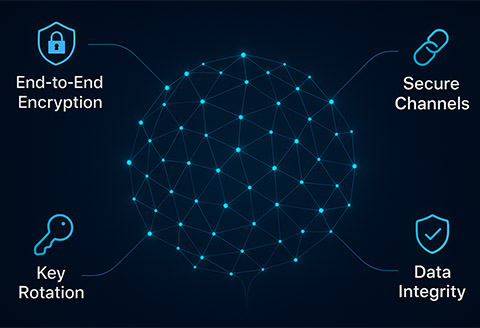
Security
End-to-end encrypted communication at every level: messages, media, control streams, metadata, routing signals.
Proprietary encryption layers, key rotation, and adaptive secure channels protect data integrity, identity, and session confidentiality even in untrusted networks.
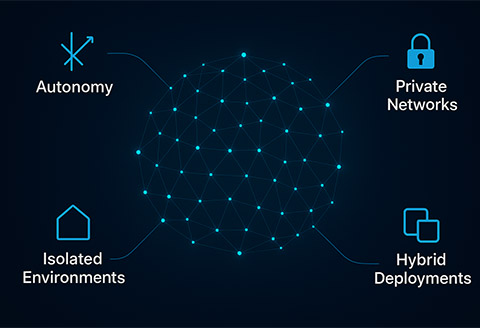
Autonomy
VOXA functions independently of traditional cloud infrastructures.
The platform can operate on private networks, isolated environments, hybrid deployments, and fully offline topologies.
Projects built on VOXA inherit the same level of independence and control.
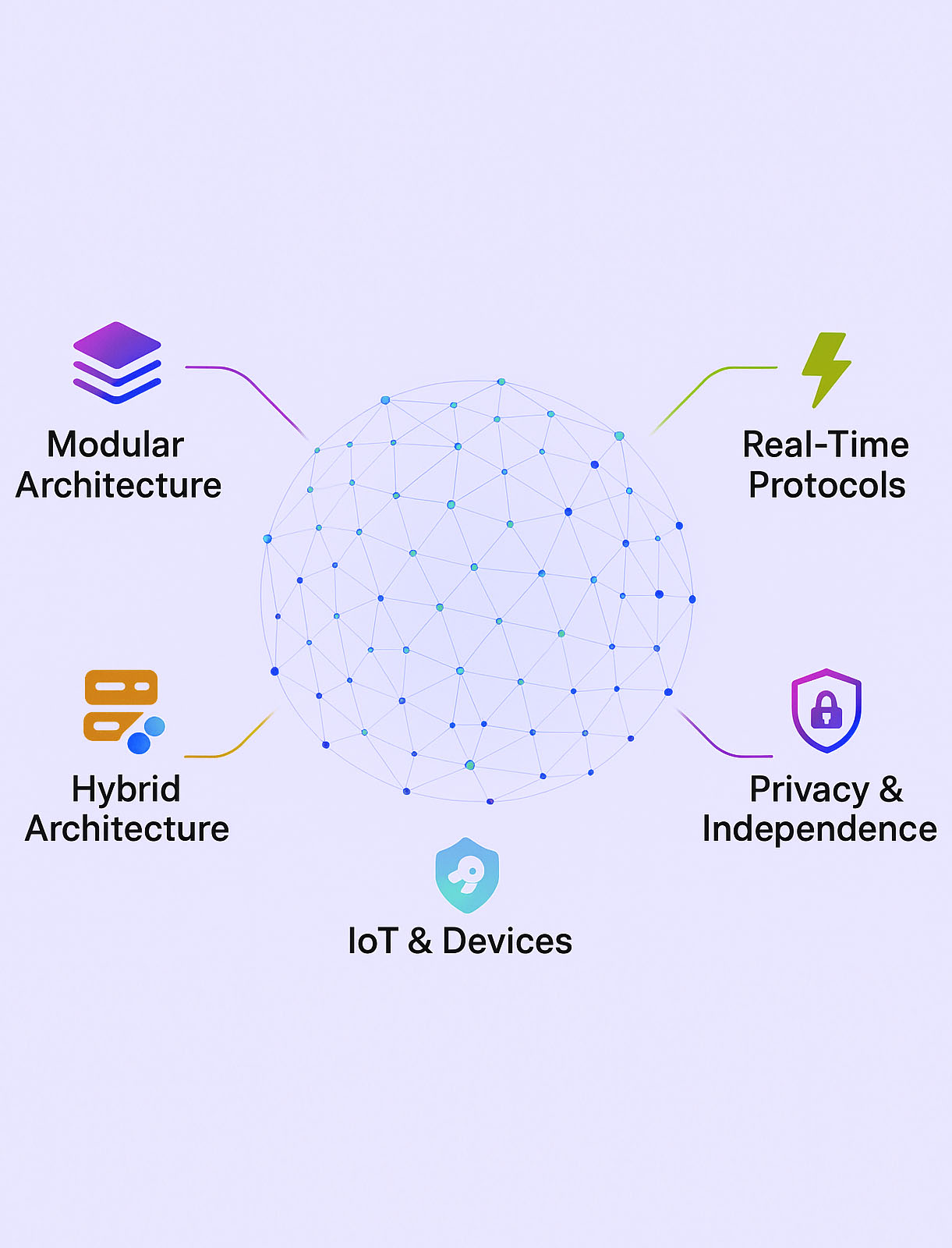
VOXA Protocol ©
A modular, protocol-based architecture for real-time communication, data transmission, media streaming, IoT operations, and privacy-centric applications.
VOXA is a secure distributed communication ecosystem built on its own transport protocol, encryption layer, and hybrid client-server + P2P architecture.
It enables developers and companies to build messaging platforms, IoT infrastructures, enterprise communication systems, media networks, and mission-critical applications with full independence and privacy.
VOXA Ecosystem
A unified technological foundation for secure, distributed, real-time communication and data exchange.
Core Capabilities of the VOXA Ecosystem:
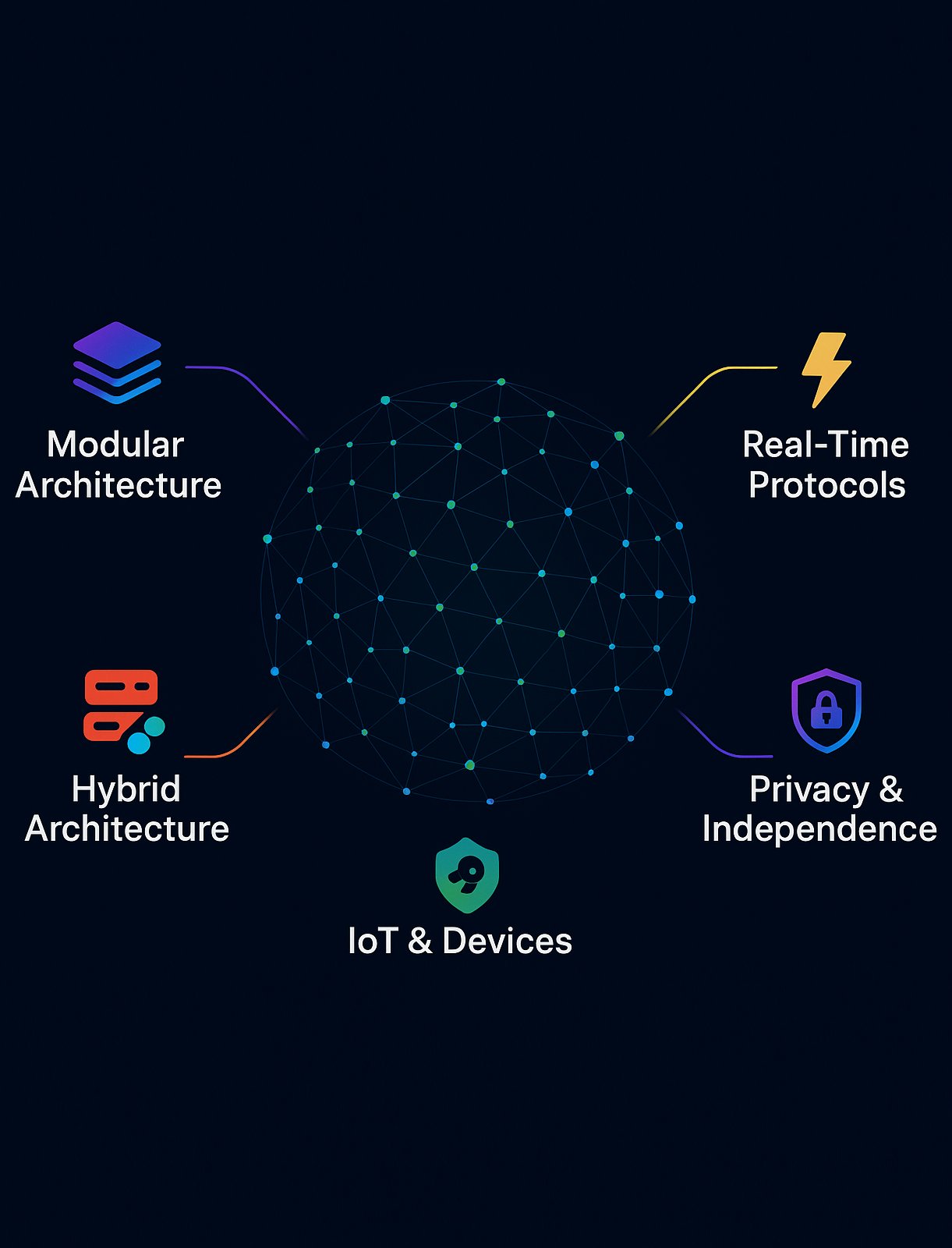
Module Architecture
Component-based design enables organizations to deploy only the required modules, integrate with existing systems, and scale without disruption.
Real-Time Protocols
Optimized for low-latency transmission of data, media, and control signals — suitable for enterprise collaboration tools, operational systems, and high-throughput environments.
Adaptive Compression
Advanced compression algorithms optimize bandwidth usage, enabling stable performance across corporate WANs, satellite links, remote sites, and unstable connections.
Unified Protocol Stack
A standard set of communication, routing, synchronization, and encryption mechanisms ensures consistent behavior across all VOXA-powered enterprise systems.
Privacy & Independence
VOXA operates fully independently of external services such as Firebase, APNs, Google Cloud, or other third-party infrastructure.
This gives enterprises complete ownership of their communication channels and transmitted data.
Multi-Layer Encryption
Protection spans all layers — from signaling and routing to user content and media streams.
Custom encryption algorithms, key rotation mechanisms, and secure handshake procedures ensure strong defense against interception and unauthorized access.
IoT & Device Connectivity
The platform supports direct communication between industrial devices, sensors, and endpoints, enabling unified IoT operations under a single protocol stack.
Cross-Platform Engine
Supports mobile, desktop, server, embedded, and private-cloud installations, enabling a unified communication layer across all corporate assets.
Offline & Low-Connectivity Mode
VOXA continues to function in partially isolated network environments and supports device-to-device or local routing when internet connectivity is unavailable.
Hybrid Networking (Client–Server + P2P)
Dynamic routing allows seamless transition between centralized and peer-to-peer communication modes.
This ensures operational continuity in restricted, segmented, or bandwidth-limited networks.
Why Enterprise Chooses VOXA
- Ensures full data ownership and compliance with internal security policies
- Operates reliably within segmented, regulated, or geographically distributed infrastructures
- Eliminates external dependencies and associated operational risks
- Integrates seamlessly with corporate IT, OT, and security environments
- Enables rapid development of bespoke communication and coordination tools
- Supports long-term scalability without locking the enterprise to a vendor-dependent cloud model

Designed for Mission-Critical Workloads
VOXA is engineered for industries where communication integrity, autonomy, and confidentiality are essential:
- Finance & Banking
- Telecommunications
- Energy & Industrial Operations
- Healthcare & Medical Infrastructure
- Enterprise Collaboration Platforms
- Transportation & Logistics
- IoT and IIoT Operational Networks
Build on VOXA
Secure Communication Platforms
VOXA enables organizations to build fully private communication systems with complete control over data, infrastructure, and security policies.
Its architecture supports encrypted messaging, voice, video, and file exchange without reliance on external providers.
This creates a foundation for sovereign, compliant, and high-trust communication products across regulated industries.
Distributed IoT & Edge Networks
With its hybrid networking model and unified protocol stack, VOXA supports secure data exchange across IoT devices, sensors, and industrial systems.
It operates reliably in low-connectivity, isolated, or high-latency environments, making it suitable for large-scale distributed operations.
Enterprises gain a resilient platform for automation, monitoring, and mission-critical device coordination.
Custom Enterprise Solutions
VOXA provides a flexible foundation for building tailored enterprise applications — from collaboration tools to workflow systems and sector-specific platforms.
Its independence from cloud vendors prevents lock-in and ensures long-term scalability and cost stability.
Organizations can rapidly develop secure, high-performance solutions aligned with their internal requirements and operational models.
VOXA for Logistics
Logistics today is simultaneously a network of people and a network of data. The sector suffers from fragmented communication channels, expensive media and telemetry traffic, slow incident detection, and limited data sovereignty. These weaknesses translate into measurable financial losses, operational risk and reputational damage. VOXA is designed to be the missing infrastructure layer – a unified, hybrid (Client-Server + P2P), E2EE-first communications and data fabric that eliminates key inefficiencies while opening new revenue and cost-saving pathways for logistics operators.
VOXA – how the architecture addresses the losses, with measurable levers
A. Hybrid P2P + Signal-Server Media
What it is: Media (voice, video, large telemetry blobs) flows peer-to-peer between endpoints wherever feasible; servers handle signalling, policy and authorization. Relay servers are used only when network conditions or policy require.
Why it matters (impact):
• Egress savings: When 60–80% of media traffic is moved off cloud relays into P2P, egress costs fall dramatically. For large fleets and frequent proof-of-delivery video, this is direct OPEX reduction. (Industry reports and operator case studies repeatedly flag egress and relay costs as a major line item.)
• Latency & UX: Direct media reduces latency – faster confirmations and fewer retransmissions. Faster confirmations cut turn-around time and delay-related penalties.
B. Native End-to-End Encryption + Local Key Control
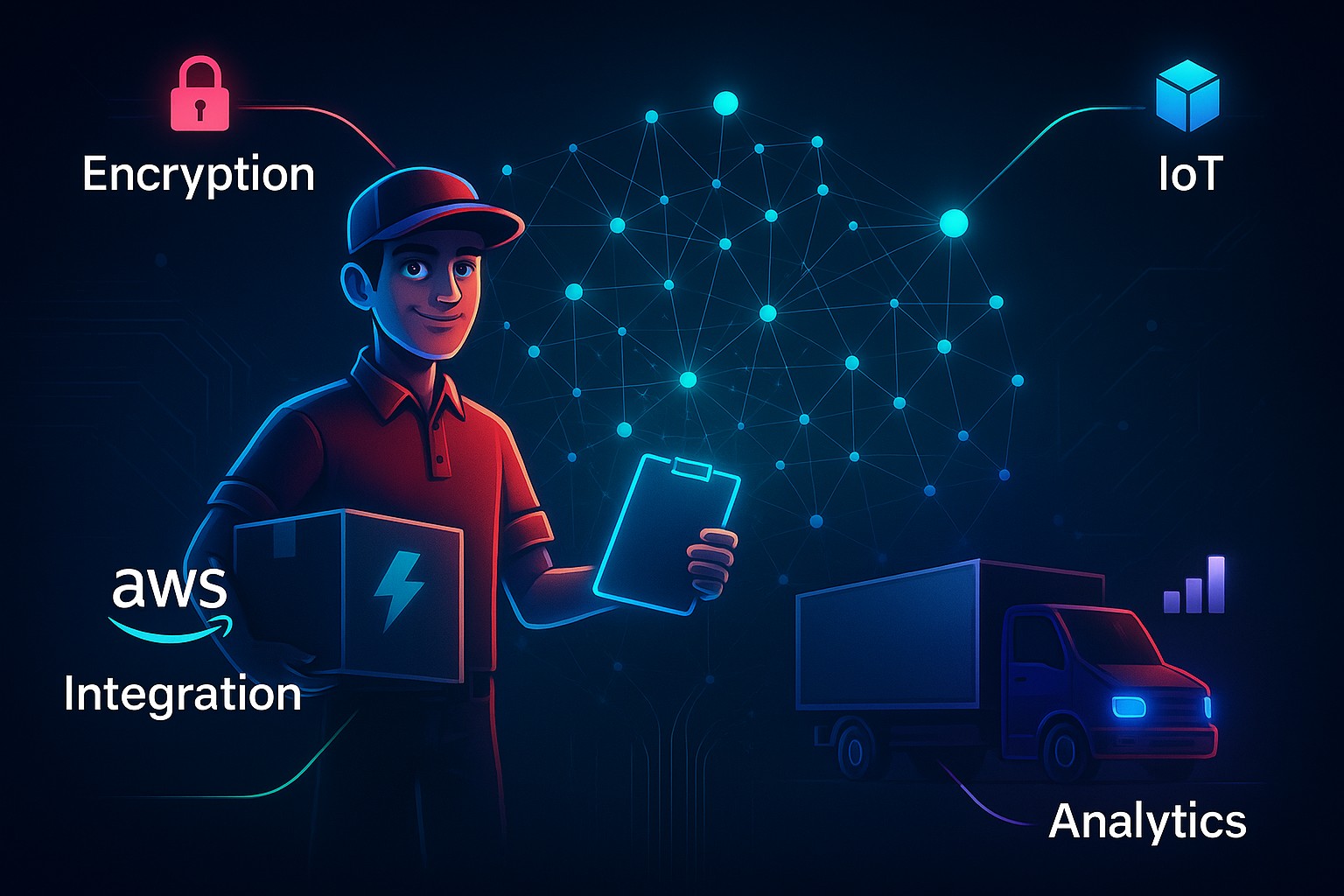
What it is: E2EE at the protocol level; keys generated on device and never stored in plaintext centrally; optional CloudHSM/AWS KMS integration for enterprise key-policy conformity.
Why it matters (impact):
• Regulatory & contractual value: Firms in pharma, healthcare, defense or regulated supply chains can keep control of sensitive metadata and payloads. Reduced compliance risk can translate into lower insurance premiums and fewer regulatory fines. (Cyber outages and data leaks are highly costly; controlling the trust anchor reduces exposure.)
C. Unified Protocol – telemetry, messaging, documents, multimedia in one frame
What it is: A single protocol with multiplexed packet types (structured parameters, telemetry arrays, chunked binary payloads) and versioned CommandIDs.
Why it matters (impact):
• Operational efficiency: Eliminates reconciliation delays between disconnected systems; reduces manual paperwork and duplicated records. McKinsey estimates show a high percentage of logistics costs stem from these inefficient interactions which VOXA directly streamlines.

D. Edge processing + adaptive compression
What it is:
Intelligent edge aggregation, selective upload of only relevant data, dynamic compression choices per payload and link quality (LZ4/Zstd, chunking).
Why it matters (impact):
• Network cost control: Less raw data to upload = lower bandwidth usage and fewer retransmits.
• Resilience: In poor connectivity, critical events can be prioritized and non-essential data deferred – preserving business continuity and reducing missed alarms.
E. Private, hybrid deployment model
What it is: VOXA runs on on-prem cores, hybrid cloud, or fully cloud depending on corporate policy. Enables private nets with geo-proxied proxy nodes and Smart GeoLoadBalancer.
Why it matters (impact):
• Data sovereignty & compliance: Full control over how and where data flows. For multinational operators, this solves jurisdictional and regulatory constraints.
• Business continuity & SLA: Operators can enforce higher SLAs and avoid third-party outages at critical points.